
Wild Fortune licence and legal status in Australia
 Available in AU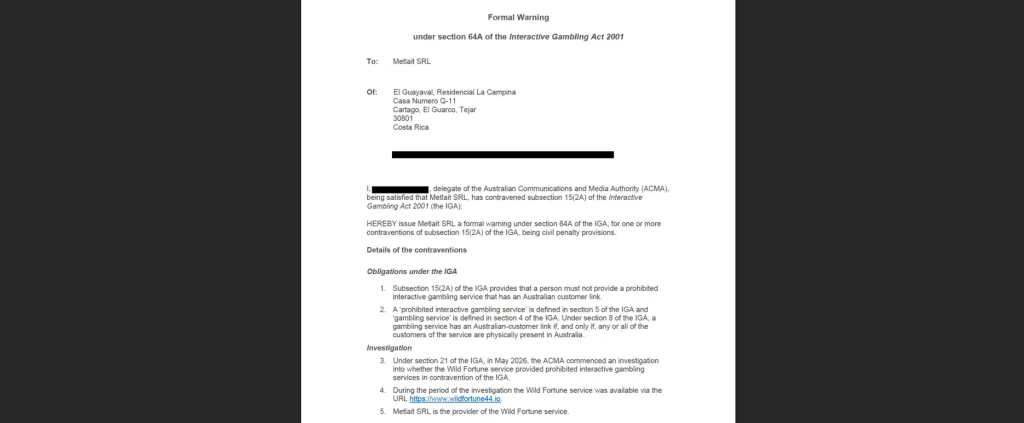
Wild Fortune is accessible through an AU-localised product, but accessibility does not make online casino play lawful for the provider in Australia. The Australian position is unusually clear because the federal regulator has taken brand-specific enforcement action against the current operator.
Table of Contents
- What the Australian ban means for Wild Fortune
- The current offshore licence behind the operator
- Consumer protection is weaker outside the domestic system
- Tax treatment should stay separate from legality
- Questions about Australian status and oversight
- The Australian status outweighs the offshore paperwork
What the Australian ban means for Wild Fortune
Australia prohibits online casino services from being provided to people physically present in the country. ACMA, the federal authority enforcing the Interactive Gambling Act 2001, issued Metlait SRL a formal warning dated 21 September 2026 and published in October 2026. The warning states that the provider of Wild Fortune contravened subsection 15(2A) by providing prohibited interactive gambling services to customers physically present in Australia.
That matters more than whether an AU-facing page loads or shows AUD. A localised interface can describe how the product is presented, but it does not create permission to provide a banned service. For an Australian reader, the practical conclusion is that Wild Fortune sits outside the domestic framework used for permitted wagering products.
- The ban applies to online casino services such as slots and casino table games offered to people in Australia.
- ACMA can investigate providers and take enforcement action under the Interactive Gambling Act.
- Brand-specific enforcement removes much of the ambiguity that sometimes exists with offshore gambling sites.
The current offshore licence behind the operator
Offshore licensing and Australian permission answer different questions. The licence helps identify the operator, the issuing authority and the framework under which the casino says it operates. Australian law answers whether that service may be offered to people located in Australia. Keeping those questions separate prevents a common analytical mistake: treating the existence of any licence as if it automatically grants access to every country.
Wild Fortune’s current terms name the Tobique Gaming Commission in New Brunswick, Canada, and licence number 0000064. The commission’s public holder table lists Metlait S.R.L. as a B2C licence holder through 16 April 2027. The company identity matches the current wildfortune.io terms, which name Metlait SRL as operator.
This is a real offshore licensing relationship, but its function is separate from Australian law. It can set obligations within the issuing framework and provide an operator identity, yet it does not authorise a provider to offer online casino services where the destination country prohibits them.
- Identify the current operator named in the casino terms.
- Match that entity against the issuing authority’s holder record.
- Check the licence number shown by the casino against the current product.
- Then assess the separate legal position in the player’s country.
For Wild Fortune in Australia, the fourth step is decisive because ACMA has already addressed the brand and operator directly.
Consumer protection is weaker outside the domestic system
The distinction becomes especially important when a balance is disputed. A domestic framework can give a customer a regulator, complaint channel and enforcement environment close to home. An offshore contract can instead require the customer to follow the operator’s internal process and then a foreign dispute route. The difficulty is not only legal wording; it is the practical cost of distance, jurisdiction and enforcement.
ACMA warns that illegal online casinos can target Australians while offering fewer practical protections than locally permitted services. In particular, Australian authorities may be unable to help recover withheld winnings or resolve poor treatment by an offshore provider. That gap is not the same thing as saying every dispute will end badly; it means the customer’s enforcement options are less direct.
Wild Fortune’s own terms route disputes first through internal handling, then to EGIS as an alternative dispute-resolution body, and they include an arbitration clause requiring arbitration in Costa Rica. That route can be more burdensome for an Australian customer than dealing with a domestic licensed service subject to local complaint channels.
| Issue | Practical route |
|---|---|
| Casino complaint | Internal Wild Fortune complaint handling first |
| Further escalation under the terms | EGIS and then the contractual arbitration route |
| Australian enforcement | ACMA enforces the ban against providers but does not function as a winnings-recovery service for customers |
If a dispute concerns verification or a pending withdrawal, the account verification guide and payments guide explain the contract conditions that can affect those stages.
Tax treatment should stay separate from legality
It is easy to confuse tax treatment with permission because both are legal questions, but they operate independently. A payment can fall within a particular tax rule without making the underlying service lawful to offer. The reverse can also happen: a lawful gambling activity can still create a tax obligation in some circumstances. That is why tax should be handled as a separate personal-finance question rather than as evidence about the casino’s regulatory position.
Australian tax treatment is a different question from whether the provider may offer an online casino service. ATO rulings generally treat gambling winnings of a person who is not carrying on a business of betting or gambling as non-assessable ordinary income, while professional or business-like gambling circumstances can be different. Individual facts matter, so anyone relying on a tax position should obtain advice from a qualified Australian tax professional.
The safer way to read the two issues is sequentially: first establish whether the service is permitted to be offered in Australia; then, if there is a tax question about money already won or lost, deal with that under tax law rather than using tax treatment as a signal that the underlying service is lawful.
Questions about Australian status and oversight
Is Wild Fortune legal for online casino play in Australia?
No. Australian law treats online casino services as a banned service category for providers offering them to people in Australia, and ACMA issued Metlait SRL a formal warning concerning Wild Fortune.
Does Wild Fortune hold an offshore casino licence?
Yes. Wild Fortune states Tobique Gaming Commission licence 0000064. The commission records Metlait S.R.L. as a B2C licence holder with validity through 16 April 2027.
Does that offshore licence change the Australian position?
No. An offshore licence does not override the Australian ban on online casino services offered to people in Australia.
What recourse does an Australian customer have in a dispute?
The terms provide internal dispute handling, EGIS escalation and arbitration in Costa Rica. ACMA also warns that Australian authorities may be unable to recover winnings or resolve treatment disputes involving illegal online casinos.
The Australian status outweighs the offshore paperwork
For dispute planning, keeping copies of account messages, withdrawal records and the operator terms that applied at the time can make the contractual route easier to follow. Those records do not create an Australian remedy, but they can make an internal complaint or external arbitration claim more concrete if a balance dispute develops.
From a decision-making perspective, that separation also prevents false reassurance. A licence can be meaningful evidence of operator identity and oversight in its own framework, yet it is not a substitute for local permission. Australian readers should therefore treat the ACMA action as the controlling local signal and the Tobique record as background on the operator.
Complaint routes are another reason to keep the local and offshore frameworks separate. The casino’s contract can describe an internal process and external arbitration, while Australian enforcement focuses on whether the prohibited service is being supplied. A customer can therefore face two parallel realities: the provider may be subject to enforcement action, yet a private balance dispute can still require the customer to follow the contract’s own escalation steps.
That gap is the practical consumer-protection issue. It is not necessary to predict that money will be lost or withheld; the concrete concern is that the customer lacks the same direct local pathway that would exist with a service operating inside an Australian permitted-gambling framework. For that reason, the brand-specific ACMA warning carries more weight for an Australian risk assessment than a generic statement that the casino has an offshore licence.
ACMA has linked Metlait SRL and Wild Fortune directly to prohibited interactive gambling services in Australia. That makes the local status brand-specific rather than an inference drawn only from a general country rule. The offshore licence identifies the operator and its external licensing framework, but it does not change the Australian prohibition.
Payment methods, game availability and loyalty features do not alter the Australian position. The local prohibition concerns the online casino service itself, regardless of which product features remain visible or accessible.
Wild Fortune has an identifiable current operator and a current Tobique licence record, but neither changes the Australian rule. ACMA’s formal warning gives the AU status a brand-specific enforcement record, while the offshore licence mainly explains who the operator is and which external framework it uses. For Australian readers, that distinction is the key point: the product can exist and hold an offshore licence while still being prohibited from providing online casino services to people in Australia.