Wild Fortune account verification and KYC
 Available in AU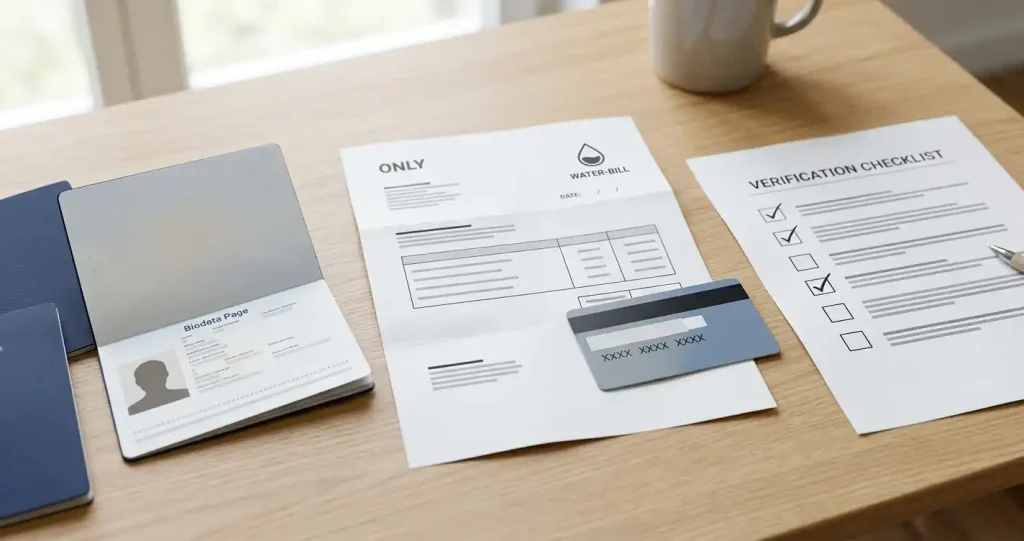
Wild Fortune’s verification rules reach beyond a one-time identity check. The operator can request documents at registration or later, hold withdrawals until checks are complete, use phone or video verification, and apply broad duplicate-account rules across households and devices.
Table of Contents
- Verification can begin at registration or later
- Phone and video checks expand the verification path
- Incomplete checks can have serious account consequences
- Duplicate-account rules reach beyond the same email address
- Questions that clarify the details
- Account reliability depends on evidence and consistency
Verification can begin at registration or later
A useful way to think about KYC is as an evidence chain. The name, address and payment ownership recorded on the account need to point to the same person. If one link is weak, the operator can ask for extra evidence to reconcile it. That is why apparently small inconsistencies can matter more at withdrawal time than they did when the account was opened.
Payment ownership is a frequent pressure point in that chain. A deposit can be technically successful even when the funding method later needs to be tied back to the account holder. Keeping a clear record of which method funded the balance makes a later verification request easier to answer.
Wild Fortune may run identity and contact checks when an account is opened or at a later point in the relationship. The terms allow requests for government-issued photo identification, proof of address, evidence tied to a payment method and further documents when additional checks are needed.
- Identity evidence links the account to a real person.
- Address evidence connects the account to the registered residence.
- Payment evidence can connect a card, bank account or other method to the customer.
- Additional documents can be requested when the standard set is not enough for the operator’s checks.
The practical consequence is that information entered during registration should be treated as something that may later need documentary support. Small spelling differences, old addresses or payment instruments held in another person’s name can become operational problems when money is pending.
Phone and video checks expand the verification path
Escalation from documents to live verification changes the practical burden on the customer. Static documents can be prepared in advance, while a phone or video step depends on current contact details, device access and the ability to respond within the requested window. Customers who travel, change numbers or use old account details can therefore encounter friction even when the underlying identity is straightforward.
The operator can require phone verification. It can also move to video verification where submitted documents do not meet its requirements. These steps mean an account can progress from static document upload to a live contact check if the initial evidence does not settle the operator’s concerns.
- The account enters a verification stage.
- Requested identity, address or payment evidence is submitted.
- The operator reviews the material and can ask for more information.
- Phone or video verification can be added where required.
- The account or withdrawal proceeds only after the required checks are satisfied.
That sequence is particularly important for customers who expect rapid withdrawals. The casino’s payment-processing target starts after approval, while verification can sit before that point. The payments guide separates those stages.
Incomplete checks can have serious account consequences
There is also a timing distinction between a routine request and a deadline-backed request. The terms include circumstances where a two-week verification or contact window applies. That makes ignoring messages risky: the consequences can move from a temporary hold to account action if the requested evidence is not supplied within the applicable period.
For record-keeping, it is sensible to retain copies of submitted documents and the date they were sent. That does not change the operator’s decision, but it gives the customer a clearer timeline if a later complaint concerns whether a request was answered.
Wild Fortune’s terms say failure to provide valid requested documents can lead to suspension or closure and forfeiture of funds. Separate anti-fraud and verification clauses also use a two-week verification or contact window in some circumstances.
This is one of the areas where responding promptly matters. A customer who ignores a request is not simply choosing to delay a withdrawal; under the stated terms, continued non-compliance can affect the status of the account and balance.
| Trigger | Possible consequence stated in the terms |
|---|---|
| Requested documents remain incomplete | Withdrawal remains pending while checks are unresolved |
| Valid evidence is not provided | Suspension or closure can follow |
| Verification/contact obligations are not met in applicable clauses | Funds can be forfeited under the stated conditions |
The safest operational approach is to keep copies of the exact information used at registration and to respond through the official account channel when a check is requested.
Duplicate-account rules reach beyond the same email address
Shared households create the hardest edge cases because overlap can be completely ordinary. Two adults may share a postal address and Wi-Fi while using separate identities and payment methods. The terms nevertheless allow several of those signals to contribute to a duplicate-account review. The practical safeguard is to avoid creating overlapping accounts casually and to clarify shared-household use before significant wagering or withdrawals create a larger financial stake.
Device reuse is similar. A family computer, shared tablet or recycled phone can create an account link even when the people are different. That makes account separation a combination of identity evidence and clean operational habits rather than a matter of email addresses alone.
The terms limit customers to one account per individual, but the duplicate-account language is broader than simply detecting two email addresses. Accounts sharing an address, household, IP connection or device can be treated as duplicates. That matters for couples, families, shared accommodation and people using a common computer or network.
Where the operator decides that accounts are duplicates, the stated remedies include closure, cancellation of pending withdrawals and forfeiture of winnings. Because those consequences are substantial, shared-device or shared-household situations are worth resolving before more than one person creates an account.
Games and account rules are separate issues. If the aim is to compare the catalogue rather than verification, the games guide keeps that discussion focused.
Questions that clarify the details
What documents can Wild Fortune request?
Wild Fortune can request government photo ID, proof of address, payment-method evidence and additional documents when its checks require them.
Can Wild Fortune use phone or video verification?
Yes. The operator can require phone verification and can request video verification when documents do not meet its requirements.
Can verification delay a withdrawal?
Yes. Withdrawals can remain pending until requested verification is completed.
How strict is the duplicate-account rule?
The terms allow one account per individual and can treat accounts sharing a household, address, IP or device as duplicates, with serious account and balance consequences.
Account reliability depends on evidence and consistency
The same evidence discipline helps with complaints. A clear timeline of registration details, document requests, submissions and withdrawal status makes it easier to distinguish an ordinary verification delay from a broader account dispute. That clarity can matter when several checks and payment stages overlap.
It also helps to separate proof from explanation. A customer may have a perfectly reasonable reason for using a shared address or device, but the operator can still ask for evidence that distinguishes the accounts. Clear documents and payment ownership usually carry more practical weight than a long narrative written after the overlap has already triggered a review.
Withdrawal planning should therefore start before the withdrawal itself. If a customer knows that identity, address and payment ownership can be requested, those records can be kept current from the beginning. That is materially different from trying to reconstruct proof after a balance has already been placed on hold.
The duplicate-account rules add a second planning layer for shared households. Two legitimate users may need to distinguish their identities, devices and funding methods clearly enough that an overlap does not look like one person operating multiple accounts. The terms still give the casino discretion, but clean separation reduces the number of ambiguous signals that can trigger a review.
The combined effect of these rules is that account quality is partly an administrative discipline. Consistent personal details, traceable payment ownership and prompt responses reduce avoidable uncertainty. They do not guarantee that every withdrawal will be immediate, because payment processing and internal review are separate stages, but they remove common reasons for a cashout to remain unresolved.
Wild Fortune’s account controls are manageable when registration details, payment ownership and identity documents align, but the terms give the operator significant discretion once they do not. Verification can expand from documents to phone or video, withdrawals can remain pending, and duplicate-account decisions can affect both access and balances.
The practical lesson is straightforward: treat account information as something that may need to be proved later, especially before building a large balance. That does not remove every dispute risk, but it reduces avoidable friction created by inconsistent details or unsupported payment ownership.